
Hi, I’m Rick Richey. I help personal trainers take control, grow their businesses, and thrive, backed by 20+ years of real-world experience.
For coaches evaluating group training space in NYC, the decision is less about square footage and more about control, consistency, and long-term sustainability.
Technical Objective
This article explains whether dedicated space is required to run group training effectively in New York City and what operational trade-offs arise when using rented or shared facilities.
It compares rented space, shared environments, and purpose-built group training studios based on their impact on coaching consistency, scheduling control, capacity management, and member experience.
The objective is to provide decision clarity for experienced coaches evaluating group training as a long-term business model in NYC.
Key Takeaways
- Running group training without dedicated space lowers fixed overhead but increases operational constraints around scheduling control, class ownership, and the ability to maintain consistent standards.
- Shared or rented environments introduce external dependencies—such as availability, setup limitations, and competing priorities—that directly affect coaching quality and member experience.
- Purpose-built group training spaces increase responsibility and financial commitment, but they allow for clearer systems, enforceable standards, and accountable decision-making.
- As class volume grows, space-related constraints affect the entire group at once, amplifying the impact of disruptions compared to one-to-one coaching.
- Decisions about space determine how much control a coach has over the group training experience itself, not just the financial profile of the business.
Performance Briefing
This topic is examined in more detail in a recorded operational briefing that focuses on how space decisions influence the long-term sustainability of group training programs.
That discussion looks more closely at how environment design, scheduling control, and spatial constraints affect coaching consistency and operational reliability as group programs mature.
A deeper analysis will be released in a future format.
What “Running Group Training” Actually Requires
Running group training is often misunderstood because it is described in surface terms: class size, workout format, or the number of people moving at the same time.
In practice, none of those elements define whether a coach is running group training as a business model.
Group training is defined by shared experience. Every decision made during a session—coaching cues, pacing, transitions, equipment use, start and finish times—affects multiple people simultaneously.
That shared exposure is what creates efficiency, but it is also what removes tolerance for inconsistency. Small breakdowns that would be isolated in one-to-one coaching become visible and cumulative in a group setting.
For group training to function well over time, it requires repeatability.
Classes need to start on time, follow a predictable structure, and deliver a consistent standard regardless of which coach is leading the session or which members are present.
This is less about programming sophistication and more about operational reliability.
Without repeatability, members experience the sessions as uneven, even if individual coaching moments are strong.
Consistency is the final requirement, and it is where many group training models quietly struggle.
Consistency applies not only to coaching standards, but to the environment itself. Floor layout, equipment availability, entry and exit flow, noise, interruptions, and reset time between classes all shape the experience.
When those variables change from session to session, coaches are forced to adapt on the fly, and standards become harder to enforce.
This is why space should be understood as an operational input, not a cosmetic one.
The physical environment determines how much control a coach has over timing, flow, setup, and execution. It either supports consistency or constantly challenges it.
Decisions about space are therefore decisions about how predictable, controllable, and sustainable the group training model can be.
In short, running group training well is not about how many people are in the room.
It is about whether the system surrounding the class—environment included—allows shared experiences to remain structured, repeatable, and consistent as volume increases.
Group Training Space in NYC: The Three Common Space Models
In New York City, group training programs tend to operate within one of three broad space models.
Each model represents a different level of control over the environment and a different relationship between the coach and the facility.
At this stage, it is important to define these models clearly, without evaluating whether they are good or bad choices.
Rented or borrowed space typically refers to hourly or off-peak use of an existing facility.
Coaches may rent studio time from gyms, martial arts schools, dance studios, or other venues that are not designed specifically for their group training sessions.
Access is usually limited to specific time blocks, and the space is reset or repurposed before and after each session.
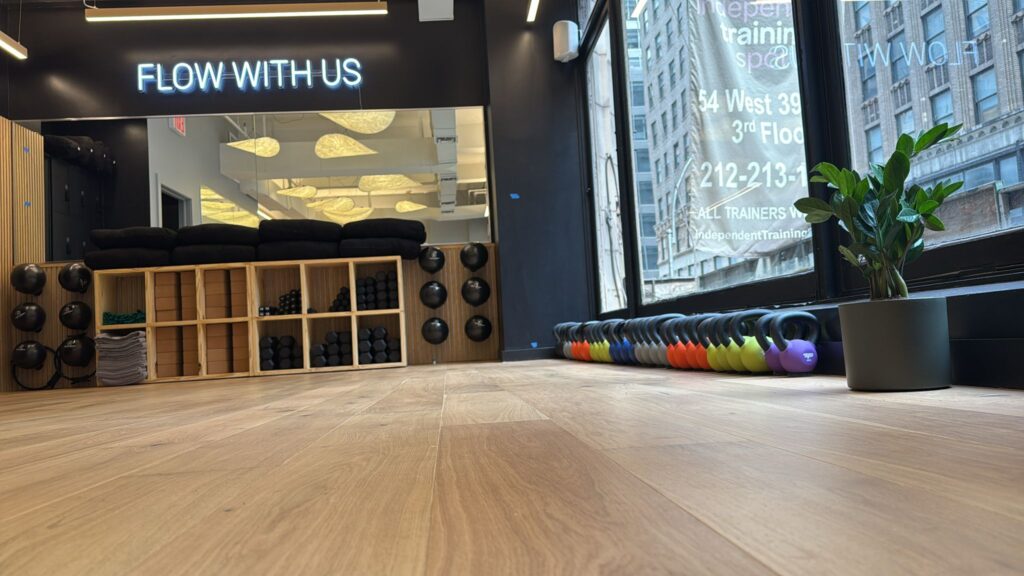
Shared or hybrid facilities are environments where multiple training models coexist under one roof.
These spaces may host personal training, semi-private sessions, group classes, and independent coaches simultaneously.
Responsibility for the environment is distributed across operators, and no single program fully controls scheduling, layout, or usage rules.
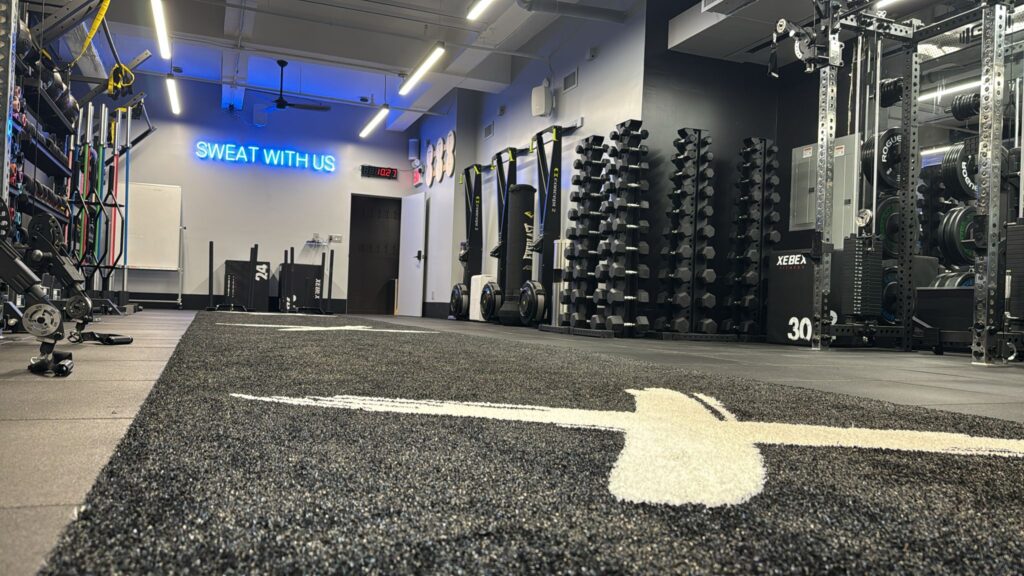
Purpose-built group training environments are facilities designed specifically to support structured group training as the primary activity.
Layout, equipment, scheduling, and flow are planned around repeatable group sessions rather than individual appointments.
Control over the environment typically sits with a single operator or system, and the space exists to serve the group model rather than adapt to multiple uses.
These three models account for the majority of group training operations in NYC. Understanding how they differ structurally provides the foundation for evaluating how each one affects the day-to-day realities of running group training over time.
Running Group Training in Rented or Borrowed Space

Running group training in rented or borrowed space is often the first entry point for coaches in NYC. It is accessible, flexible, and keeps fixed costs low.
In the short term, this model can work, particularly for testing demand or transitioning from one-to-one coaching. The constraints tend to emerge as soon as volume, frequency, or expectations increase.
The first limitation is scheduling fragility.
When access to space is tied to hourly availability or off-peak windows, the schedule is inherently vulnerable. Classes may need to move, compress, or cancel based on changes outside the coach’s control.
This makes long-term planning difficult and places pressure on members to adapt rather than rely on predictable routines.
There is also limited class ownership. In borrowed environments, the class exists temporarily within someone else’s system.
Coaches may not control arrival flow, warm-up space, storage, or transition time between sessions. That lack of ownership often shows up in small but compounding ways, such as rushed starts, delayed finishes, or inconsistent setup from class to class.
Setup and teardown friction is another defining feature. Equipment often needs to be moved, rearranged, or packed away before and after each session.
While manageable at low volume, this friction consumes time and energy that would otherwise be spent coaching or maintaining standards. Over time, it becomes a hidden tax on consistency, particularly when multiple sessions are run back-to-back.
These constraints contribute to an inconsistent member experience.
Even when coaching quality is high, variability in space availability, layout, and timing can make sessions feel uneven. Members experience the program as dependent on circumstance rather than system, which becomes more noticeable as expectations rise.
Rented or borrowed space is therefore best understood as a workable short-term solution, not a structurally neutral one.
It allows group training to operate, but it does so within boundaries that limit control, repeatability, and scalability. Those limits may be acceptable early on, but they become increasingly visible as the group training model matures.
Operating Groups Inside Shared or Hybrid Facilities

Shared or hybrid facilities offer more stability than hourly rentals, but they introduce a different set of structural considerations.
These environments typically support multiple training models at once—personal training, semi-private sessions, classes, and independent coaches—each with its own priorities and operating rhythms.
Group training can function in this setting, but it does so within a web of shared interests rather than a single, unified system.
One of the primary challenges is conflicting priorities between operators.
Decisions about scheduling, equipment use, floor layout, and noise are often made to accommodate the facility as a whole rather than the specific needs of group training. When multiple programs compete for the same resources, compromises are unavoidable.
Over time, those compromises tend to affect group sessions more acutely because they rely on predictable flow and shared timing.
This environment also creates standards dilution. When no single operator fully owns the space, it becomes harder to enforce consistent expectations around setup, transitions, cleanliness, and class boundaries.
Even well-intentioned facilities can struggle to maintain uniform standards when responsibility is distributed across multiple users.
For group training, where consistency is central to the experience, this dilution can be difficult to offset through coaching alone.
Another consequence is member confusion around ownership and identity.
In shared spaces, it is not always clear who the group training program belongs to or how it fits within the broader facility.
Members may encounter different rules, coaches, or expectations depending on the time of day or area of the gym. This lack of a clear environmental identity can weaken the sense of structure that group training depends on.
Finally, there is an ongoing dependence on external decision-making.
Changes to hours, policies, pricing, or layout are often outside the direct control of the group training operator. Even small adjustments can have disproportionate effects on class flow and scheduling.
This dependence introduces uncertainty into what should otherwise be a repeatable system.
In shared or hybrid facilities, group training does not fail because the environment is inadequate. It struggles because control is diffused.
As more responsibility shifts away from the group operator, maintaining consistent standards and experience requires increasing effort, often with diminishing returns.
What Changes When a Space Is Purpose-Built for Group Training
When a space is designed specifically for group training, the underlying operating conditions change in fundamental ways.
The most significant shift is clear class ownership. The group session is no longer a temporary activity within someone else’s system; it becomes the primary function of the space.
This clarity removes ambiguity around who sets standards, how sessions run, and what the environment is designed to support.
A purpose-built environment also creates environmental consistency.
Layout, equipment placement, entry and exit flow, and reset processes remain stable from session to session.
Coaches are no longer adapting their delivery to fit the room on a given day. Instead, the room supports the delivery of the class.
Over time, this consistency reduces cognitive load for both coaches and members, making standards easier to maintain.
Predictable scheduling is another defining change. Because the space exists to serve group sessions, class times are not squeezed into gaps or adjusted around competing uses.
Sessions start and finish when planned, transitions are built into the schedule, and members experience the program as reliable rather than conditional.
This predictability becomes increasingly important as attendance grows and members structure their routines around the classes.
These benefits come with higher fixed responsibility.
A dedicated group training space increases financial commitment and operational accountability. Decisions about utilisation, staffing, maintenance, and standards cannot be deferred to another operator.
The environment reflects the system behind it, for better or worse. This responsibility is not a downside in itself, but it does require a coach to be ready to operate at a system level rather than relying on flexibility alone.
Group by ITS exists as an example of a purpose-built group training environment. Its design reflects the assumption that group training is not an add-on, but a primary operating model.
The relevance of such spaces is not that they are inherently superior, but that they make the trade-offs of group training explicit by placing control, consistency, and accountability in one place.
What changes most in a purpose-built environment is not the workout itself, but the degree of control over the conditions that shape every session.
How Space Constraints Affect Coaching, Not Just Logistics
Space decisions are often framed as logistical considerations—where sessions take place, how equipment is stored, or how many people can fit in the room.
In practice, these constraints reach much deeper. They directly influence how coaches coach, not just how classes are organised.
When space is limited or unpredictable, coach attention comes under pressure.
Coaches are required to manage congestion, adapt movements to fit the room, and resolve spatial conflicts in real time. Each of these demands pulls attention away from observation, cueing, and correction.
Over time, coaching becomes more reactive, with energy spent on managing the environment rather than developing the group.
Class flow disruptions are another common outcome.
Inconsistent layouts, shared equipment zones, or tight transition windows interrupt the natural rhythm of a session. Coaches may shorten warm-ups, rush transitions, or extend rest periods to accommodate the space rather than the intent of the class.
These adjustments are often subtle, but they accumulate and change the character of the training.
As volume increases, these issues lead to compromised standards.
What is manageable with a small group becomes increasingly difficult to maintain as attendance grows.
Coaches begin to make allowances—less precise movement standards, simplified progressions, or reduced individual feedback—not because of lack of skill, but because the environment no longer supports the level of attention required.
The key point is that space constraints shape coaching behaviour.
They determine how much attention a coach can give, how consistently standards can be applied, and how effectively a group can be led as a unit. Decisions about space are therefore decisions about coaching quality.
The environment either reinforces the standards a coach wants to uphold or quietly erodes them as pressure increases.
Where Group Training Breaks Down Without Environmental Control
What I see most often in NYC is not a single point of failure, but a gradual accumulation of friction. Group training rarely breaks because of one bad class or one poor decision. It breaks when small, unresolved constraints compound over time.
Where systems start to fray is usually around control. Classes begin to rely on workarounds rather than structure.
Coaches adapt session flow to fit the room instead of the room supporting the session. Start times drift, transitions tighten, and standards become situational rather than consistent.
None of these issues feel critical in isolation, but together they erode reliability.
Another common pattern is energy leakage.
Coaches spend increasing amounts of time managing space-related issues—rearranging equipment, negotiating shared areas, adjusting plans mid-session. That effort is rarely visible to members, but it reduces the attention available for coaching.
Over weeks and months, this leads to fatigue, reduced precision, and a subtle lowering of expectations.
Member experience degrades in similar ways.
When the environment changes from session to session, members stop experiencing the program as a system and start experiencing it as a series of exceptions. The class feels dependent on circumstances rather than structure.
As attendance grows, those inconsistencies affect everyone at once, amplifying their impact.
The breakdown rarely announces itself. It shows up as friction that feels manageable until it isn’t. Without environmental control, group training becomes increasingly fragile, not because the coaching is weak, but because the system surrounding it cannot absorb growth without distortion.
How Dedicated Group Environments Change Operator Responsibility
Moving into a dedicated group training environment fundamentally changes the role of the operator.
The most obvious shift is that more control comes with more accountability. When the space exists specifically to support group training, there are no external factors to defer to.
Scheduling, standards, utilisation, and experience all sit within one system. If something breaks, it is clear where responsibility lies.
This level of control removes many of the constraints present in rented or shared environments, but it also removes excuses.
Coaches are no longer adapting to someone else’s rules or limitations. The environment reflects the decisions made by the operator. That clarity can be confronting, but it is also what allows systems to function cleanly.
There is also less flexibility, but more clarity.
Dedicated environments are less forgiving of ad hoc decisions. Classes run when they are scheduled to run. Equipment lives where it is meant to live. Standards are defined and enforced because the space is designed to support them.
This reduces the day-to-day improvisation that often masks deeper structural issues in more flexible setups.
From an operator perspective, this shift requires a different mindset.
The role moves away from problem-solving around constraints and toward maintaining systems that work at volume. That includes being deliberate about capacity, staffing, scheduling, and the experience members are meant to have every time they walk through the door.
Rick Richey has operated across multiple models and seen both sides of this trade-off.
The value of a dedicated group environment is not that it simplifies the business, but that it makes responsibility explicit. For coaches prepared to operate at that level, the clarity can be stabilising.
For those relying on flexibility to compensate for weak systems, it often exposes where changes are needed.
Ultimately, dedicated group environments do not reduce the demands of group training. They concentrate them. The difference is that they place control and accountability in the same place, which is where sustainable systems tend to emerge.
7. Further Reading
The following articles expand on the operational themes discussed above and provide additional context for coaches evaluating group training as a long-term model:
7. Further Reading
The following article expands on the economic and operational considerations discussed above and provides additional context for coaches evaluating group training as a long-term model:
- Is Group Training Actually More Profitable Than 1-to-1 Coaching?
A comparison of revenue efficiency, operational load, and where group training creates hidden constraints as volume increases.
Frequently Asked Questions
Do you need your own space to run group training successfully in NYC?
Dedicated space is not strictly required to run group training in NYC, but it increases control over scheduling, environment, and standards. When space is shared or rented, external constraints affect how consistently sessions can be delivered as volume and expectations grow.
What problems arise when running group training in rented space?
Rented space introduces scheduling fragility, setup and teardown requirements, and limited control over the environment. These factors increase operational friction and make it harder to maintain consistent class flow and coaching standards over time.
How does shared space affect group training consistency?
Shared space reduces environmental control because multiple programs and operators influence layout, scheduling, and usage rules. This variability makes it harder to deliver a repeatable experience across sessions, even when coaching quality is high.
Why does space control matter more as class size grows?
As class size increases, any disruption caused by space limitations affects all participants simultaneously. This amplifies the impact of scheduling changes, layout constraints, and flow interruptions, increasing pressure on coaching attention and standards.
Is owning or leasing space required to scale group training?
Owning or leasing space is not required in all cases, but scaling group training typically requires predictable access and environmental control. Without these conditions, growth increases complexity faster than systems can absorb it.
What trade-offs come with purpose-built group training environments?
Purpose-built environments increase fixed costs and operational responsibility while providing greater control over scheduling, layout, and standards. This trade-off concentrates accountability but allows systems to function more reliably at scale.
How does space choice affect member experience in group settings?
Space choice influences consistency, flow, and predictability. When the environment changes from session to session, member experience becomes dependent on circumstance rather than system, which becomes more noticeable as group size increases.
Next Steps
If you’re deciding whether group training fits your model long term, the next step is usually seeing how different environments operate in practice. Observing how space, scheduling, and standards are handled day to day often provides more clarity than theoretical comparisons.
For some coaches, that means spending time inside a dedicated group training environment to understand how control and accountability are managed in real conditions. Others may benefit from stepping back and reviewing the broader demands of operating independently before committing to a group model.
- To explore how a purpose-built group training environment operates in practice, you can learn more here:
https://groupbyits.com/start/ - If you’re still evaluating your overall path as an independent coach, this free resource provides broader context on business structure and decision-making before moving into group training:
https://go.independenttrainingspot.com/independent-trainer-book
The goal is not to move quickly, but to make a decision that aligns with how you want to operate over time.