
Hi, I’m Rick Richey. I help personal trainers take control, grow their businesses, and thrive, backed by 20+ years of real-world experience.
Becoming an independent personal trainer can give you more freedom, more control and more earning potential.
It can also give you longer hours, less certainty and a business that depends entirely on you.
That is the part trainers do not always hear before they make the move.
Independence is often presented as the obvious next step. You leave the commercial gym, take your clients with you, set your own schedule and finally build something on your own terms.
Sometimes that is exactly what happens.
But not always.
Over the years, I have watched hundreds of trainers make the move into independence.
Some built strong, sustainable businesses and never looked back.
Others discovered that being a great coach and running a successful independent business are two very different things.
The difference was rarely talent.
It was usually whether they understood what independence would actually require before they stepped into it.
You are no longer only responsible for coaching.
You are responsible for finding clients, keeping them, managing your schedule, handling the money, solving problems and making decisions when there is nobody else to make them for you.
That does not mean independence is the wrong move.
It means it should be a deliberate move, not an emotional reaction to a bad manager, a frustrating gym or the belief that working for yourself must automatically be better.
This article is not here to persuade you to leave your gym.
It is here to help you decide whether becoming an independent personal trainer is genuinely the right move for you, what changes when you do it, and whether you are ready for the responsibility that comes with the freedom.
Why are so many trainers thinking about going independent?

More trainers are considering independence because they want greater control over how they coach, who they work with and what they earn.
They want the freedom to build a business that reflects their own values rather than someone else’s. Those motivations are completely understandable, but they are only part of the decision.
For most trainers, the desire to become independent does not appear overnight.
It usually starts with small frustrations that build over time. You may be working split shifts that leave little room for family or recovery. You may be watching clients achieve great results while knowing a significant percentage of every session fee goes to the gym.
Or perhaps you have developed your own coaching philosophy but still find yourself working within systems, pricing structures or programming that do not reflect how you believe people should be coached.
After a while, it is natural to start asking yourself, “What if I did this on my own?”
There are good reasons why that question keeps coming up. Working independently can give you more control over your schedule, the opportunity to earn more from the clients you already serve, and the freedom to create an experience that genuinely reflects your approach to coaching.
You decide how long sessions last, what services you offer, how you communicate with clients and the kind of community you want to build around your business.
For many coaches, that is incredibly appealing. But after watching trainers make this transition for more than two decades, one pattern has become very clear: very few people decide to become independent because everything is going brilliantly.
More often, they are frustrated.
They are frustrated with split shifts, inconsistent income, sales targets, limited freedom, management decisions they do not agree with, or the feeling that they are working hard to build someone else’s business instead of their own.
Those frustrations are real, and they can be an important catalyst for positive change.
Where trainers sometimes get caught out is assuming that frustration automatically means they are ready for independence. It does not. Frustration explains why you want to leave, but it does not tell you whether you are prepared for what comes next.
The trainers who build sustainable independent businesses are not simply trying to escape something. They are moving towards something with a clear plan, realistic expectations and a genuine understanding of what running a business actually involves.
Before you convince yourself that independence is the right next step, ask yourself one simple question:
Am I moving towards a business I have deliberately planned, or am I simply trying to escape a situation I no longer enjoy?
Those two decisions may look similar from the outside, but in practice they often lead to very different outcomes.
What actually changes when you become an independent personal trainer?
One of the first things I tell trainers who are thinking about becoming independent is that your coaching probably won’t change very much.
You’re still helping people move better, get stronger, lose weight, recover from injuries or achieve whatever goals brought them to you in the first place. If you’re already a good coach, you’ll probably continue to be a good coach.
What changes is everything that happens before and after the session.
When you’re employed by a commercial gym, it’s easy to underestimate just how much of the business someone else is running for you.
The lights come on every morning. The equipment is serviced. Memberships are sold. Payments are collected. Marketing campaigns happen in the background. Reception deals with enquiries. Problems get solved, often without you even knowing they existed.
As a coach, you get to focus on coaching.
When you become independent, all of those responsibilities move a little closer to you.
That doesn’t mean you’re suddenly spending every evening buried in spreadsheets or worrying about invoices.
In fact, many independent trainers quickly discover they enjoy having more control over how they run their business. What catches people by surprise is simply the number of decisions they’re now responsible for making.
If your diary starts looking quiet, there’s nobody else responsible for finding your next client.
If a long-term client leaves, you need a plan for replacing them. If your prices haven’t changed for three years, you’re the one who has to decide whether it’s time to increase them.
One of the biggest practical decisions you’ll eventually face is whether renting studio space or working on a revenue-share model makes the most sense for your business.
If you’re weighing up those options, our guide to Gym Rental vs Revenue Split in NYC explains the advantages and trade-offs of each approach.
Even taking a holiday becomes a business decision because you’re balancing time away against income that may temporarily stop while you’re not coaching.
None of those responsibilities are negative. They’re simply different.
In many ways, that’s exactly what independence offers. You gain the freedom to decide how your business operates, the type of clients you work with, the experience you create and the direction you want your business to take.
For many trainers, that’s incredibly rewarding because they no longer feel constrained by someone else’s systems or priorities.
The trade-off is that freedom and responsibility arrive together. You can’t really separate one from the other. The decisions that were once made for you now become yours, and while that can feel daunting at first, it’s also what gives you the opportunity to build something that genuinely reflects who you are as a coach.
Over the years, I’ve noticed that the trainers who thrive as independents aren’t always the most technically gifted.
They’re the ones who gradually stop thinking like employees and start thinking like business owners.
They understand that every interaction with a client, every referral, every follow-up email and every decision about their service contributes to something much bigger than the next session.
They’re building a reputation, not just delivering workouts.
That’s why I don’t think the biggest question is whether you can become an independent personal trainer. Most experienced coaches probably can.
The better question is whether you’re excited by everything that comes with it. Because if the idea of building a business genuinely motivates you as much as coaching people does, independence can be one of the most rewarding decisions you’ll ever make.
If, however, you’re simply hoping to coach exactly as you do now without taking on any additional responsibility, the reality may be very different from what you’re imagining.
As you continue reading, the next question becomes even more important. Understanding what changes is one thing. Knowing whether you’re actually ready for those changes is something else entirely.
What do most trainers get wrong about going independent?

After you’ve worked in a commercial gym for a few years, it’s easy to start imagining what life would look like if you worked for yourself instead.
Most of those thoughts are perfectly reasonable. You picture choosing your own hours, keeping more of what you earn, working with the clients you really enjoy and having the freedom to build a business that reflects your own approach to coaching.
None of those things are unrealistic.
The mistake is assuming that’s the whole picture.
Over the years, I’ve had countless conversations with trainers who were thinking about making the move into independence.
What’s interesting is that they rarely ask about coaching. They’re confident in their ability to help people.
The questions are almost always about everything else.
- “Will I earn more money?”
- “Will my clients come with me?”
- “How do I find new clients?”
- “Will I finally have more freedom?”
They’re good questions, but they’re often based on assumptions that haven’t yet been tested.
One of the most common is the belief that becoming independent automatically means earning more money. It certainly can, but only if you’re prepared to build a business alongside your coaching.
Earning more isn’t simply a result of leaving your gym. It comes from consistently attracting new clients, retaining the ones you already have, charging appropriately for the value you provide and running your business well over a long period of time.
Another assumption is that your existing clients will naturally follow you wherever you go.
Some probably will. Others won’t, and often for reasons that have nothing to do with you.
Their membership may include training, your new location may no longer be convenient, or they may simply prefer the familiarity of where they are. It’s dangerous to build your plans around an outcome you can’t completely control.
Marketing is another area that surprises people.
Many trainers assume that if they’re good at coaching, word will naturally spread. Sometimes it does, particularly if you’ve spent years building strong relationships and a good reputation.
More often, though, successful independent trainers are intentional about staying visible. They keep in touch with past clients, ask for referrals, build relationships within their community and make sure people know who they help and how they help them.
Marketing isn’t something you do because your coaching isn’t good enough. It’s how people discover that your coaching exists in the first place.
Perhaps the biggest misconception of all is that independence automatically gives you more free time.
Eventually, it might. In the early days, however, many trainers find themselves investing time in areas they never had to think about before. They’re learning how to run a business as well as how to coach, and that learning curve takes time.
None of this is meant to discourage you.
Quite the opposite.
I think it’s important to understand what independence really looks like because the trainers who succeed aren’t the ones who expect it to be easier.
They’re the ones who expect it to be different. They embrace the opportunity to build something of their own while recognising that every opportunity comes with responsibility.
If you begin your independent journey with realistic expectations instead of idealised ones, you’ll make better decisions, adapt more quickly when challenges arise and give yourself a much stronger foundation for long-term success.
That’s why the question isn’t whether independence is a good idea.
The real question is whether this is the right time for you to make that move.
How do you know if you’re actually ready?
One of the questions I’ve been asked more than almost any other over the years is, “How do I know when I’m ready to become independent?”
The honest answer is that there isn’t a single moment when someone suddenly becomes ready.
There isn’t a qualification you can earn, a certain number of years you need to work or a magic number of clients that tells you it’s time.
I’ve seen trainers with decades of experience struggle when they went out on their own, and I’ve seen others make a successful transition much earlier because they understood what independence would demand of them.
That’s why I’ve stopped thinking about readiness as a yes-or-no decision.
Instead, I think of it as a progression.
Over the years, I’ve watched trainers move through the same broad stages. Everyone moves at a different pace, and not everyone reaches the final stage, but the journey is remarkably consistent.
I call it The Independence Readiness Spectrum.
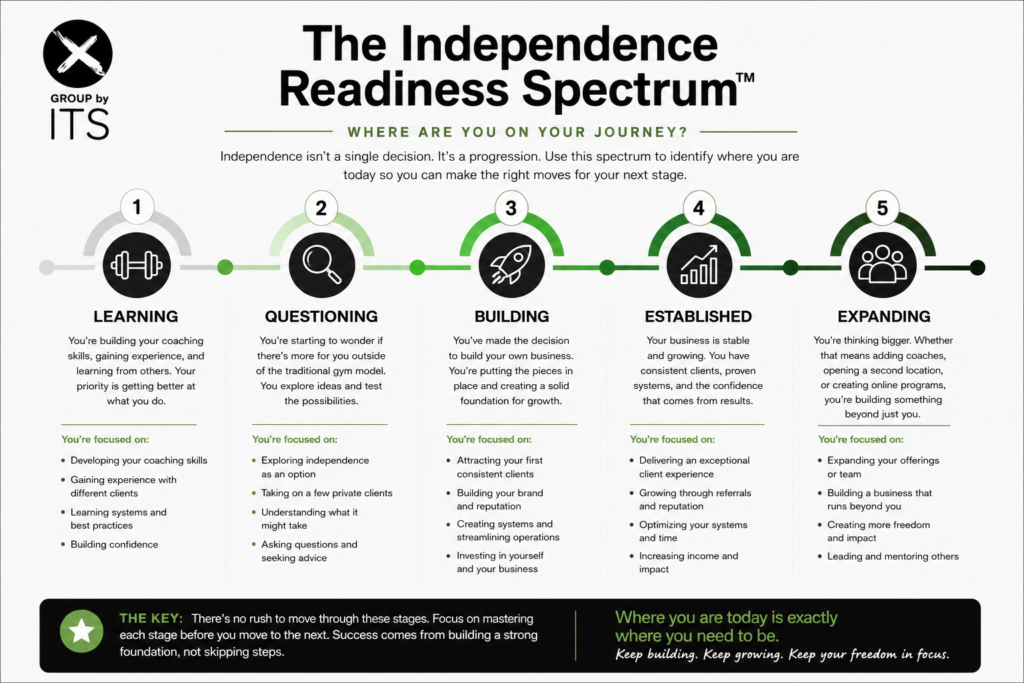
The purpose of the spectrum isn’t to tell you where you should be. It’s to help you recognise where you are today, because the decisions that are right for one stage can be completely wrong for another.
Stage One: Learning
Every trainer starts here. Your priority isn’t building a business. It’s becoming a great coach. You’re developing your technical knowledge, learning how to communicate with clients and gaining the experience that only comes from coaching real people.
Working in a commercial gym is often one of the best places to do that because it exposes you to a wide variety of clients and gives you opportunities to coach that would be difficult to create on your own.
Investing in recognised education and continuing professional development through organisations such as the National Academy of Sports Medicine (NASM) can also help you build the confidence and coaching skills that form the foundation of a successful long-term career.
There’s no rush to leave this stage. In fact, many trainers move on too early because they confuse confidence with competence.
Stage Two: Questioning
At some point, many trainers begin to wonder whether they’re building someone else’s future instead of their own.
You start asking different questions.
Could I earn more if I worked for myself? Would my clients follow me? Could I coach the way I really want to coach?
The idea of independence becomes increasingly attractive, but you’re still exploring what it might look like rather than actively building it.
This is often where frustration appears. That’s perfectly normal. Just remember that frustration is a reason to explore your options, not a reason to rush your decision.
Stage Three: Building
This is where independence stops being an idea and starts becoming a plan.
You’re deliberately creating the foundations of your own business.
You understand that coaching is only one part of the job, so you’re learning how to attract clients, build relationships, generate referrals and create systems that make your business more sustainable.
You may still be employed while you do this, or you may already be working independently, but your focus has shifted from simply delivering sessions to building something that can support you for years to come.
This is where I see many of the trainers at Group by ITS. They haven’t finished the journey—they’ve committed to it.
Many instructors reach the point where they need a professional place to coach without committing to the cost and responsibility of opening their own facility.
That’s exactly why we created Group by ITS, giving independent instructors access to fully equipped studio space while they build their business.
Stage Four: Established
By this stage, your business has developed stability.
You’re no longer worrying where your next client is coming from every month because you’ve built a reputation, your existing clients generate referrals and your systems are working consistently.
That doesn’t mean every week is perfect, but the business no longer feels fragile.
Perhaps the biggest difference is your confidence. Decisions become calmer because they’re based on experience rather than hope.
Stage Five: Expanding
Not every independent trainer wants to reach this stage, and that’s absolutely fine.
Some people love coaching and have no desire to manage a team or run a larger business.
Others discover they enjoy building organisations as much as they enjoy coaching. They open studios, employ coaches, develop education, create online programmes or expand into new opportunities.
Neither path is better than the other.
Success isn’t determined by how big your business becomes. It’s determined by whether you’ve built a business that supports the life you want to live.
When trainers ask me whether they’re ready to become independent, I’m rarely thinking about their coaching ability.
I’m thinking about where they sit on this spectrum.
Because becoming independent isn’t a single decision. It’s a progression.
The more honest you are about where you are today, the more likely you are to make decisions that set you up for long-term success rather than short-term excitement.
Before you move on, ask yourself one question:
Which stage best describes where you are today—not where you hope you are, but where you honestly are?
The answer will tell you far more about your readiness than any qualification, certification or number of years in the industry ever could.
Which path is right for you?

By now, you’ve probably realised that this isn’t really about choosing between employment and independence. It’s about choosing the business model that best fits where you are today.
Every option has advantages. Every option has trade-offs. The mistake is assuming there’s a single “right” answer for everyone.
I’ve put together a simple comparison to help you think about the differences. Don’t use it to decide which path is best in general. Use it to decide which path makes the most sense for you at this stage of your career.
| Commercial Gym | Independent Training Environment | Own Studio | |
| Income Potential | Shared through salary, commission or revenue split | Higher earning potential with lower overheads | Highest ceiling, but highest financial exposure |
| Security | More predictable income and established systems | Income depends on your client base, but fixed costs remain relatively low | Greater financial risk due to leases, staffing and operating costs |
| Control | Limited control over pricing, programming and schedule | High level of control while sharing professional facilities | Complete control over every aspect of the business |
| Responsibility | Coaching is the primary focus | Coaching plus running your own business | Coaching, business management and facility management |
| Growth Potential | Often limited by the employer’s structure | Strong growth through reputation, referrals and systems | Potentially unlimited, but requires significant investment and leadership |
| Lifestyle | More structured working week | Greater flexibility with greater personal responsibility | Less flexibility initially as the business demands more of your time |
| Best Suited To | Coaches developing experience | Trainers ready to build an independent business | Established operators looking to build a larger organisation |
One thing I’ve learned over the years is that the happiest trainers aren’t necessarily the ones who earn the most or own the biggest businesses. They’re the ones whose business model matches the life they’re trying to build.
Some people love the structure and support of a commercial gym. Others thrive on the freedom of building an independent business. Some eventually go on to open their own studios, while others realise they never actually wanted that responsibility in the first place.
Success isn’t about reaching the final column. It’s about choosing the path that allows you to do your best work while building the life you want outside the gym.
Five Things I’ve Learned After Two Decades Working With Independent Trainers

One of the things I’ve enjoyed most about running Independent Training Spot over the years has been watching trainers build their own businesses.
Some arrived with a clear plan and a growing client base. Others simply knew they wanted something different from the commercial gym environment but weren’t entirely sure what that looked like yet.
Not every journey has been the same, and not everyone has achieved the same outcome.
Some trainers have gone on to open their own studios, while others have built successful independent businesses that give them exactly the lifestyle they wanted.
I’ve also seen trainers decide that independence wasn’t the right fit for them after all, and there’s nothing wrong with that either.
Watching those journeys unfold has taught me that success has surprisingly little to do with finding the “perfect” business model.
Instead, the same patterns tend to appear over and over again, regardless of a trainer’s age, experience or qualifications.
The first pattern is that being an exceptional coach doesn’t automatically translate into building an exceptional business.
That’s probably one of the biggest misconceptions in our industry. Coaching is the foundation, but it’s only one part of the equation.
The trainers who build long-term businesses are usually the ones who become just as interested in relationships, communication, client experience and consistency as they are in programming and exercise selection.
They recognise that clients stay for far more reasons than simply receiving a good workout.
I’ve also noticed that the trainers who build the strongest businesses rarely think in terms of weeks or even months.
They think in years. They understand that reputations are built gradually, one client at a time.
Every positive experience, every referral, every conversation and every recommendation adds another brick to the business they’re trying to build.
None of those moments feel particularly significant on their own, but over time they become incredibly valuable because they’re almost impossible for a competitor to replicate.
Another lesson I’ve learned is that marketing isn’t really what most trainers think it is.
People often imagine marketing means creating more content or spending more money on advertising.
In reality, the most successful independent trainers I’ve worked with have usually built businesses because people trust them.
Clients recommend them to friends, healthcare professionals feel confident referring people to them, and local communities begin to recognise them as the person to speak to about a particular problem.
That’s not marketing in the traditional sense. It’s the result of consistently delivering a great experience over a long period of time.
Something else that stands out is the way successful independent trainers deal with problems.
Every business encounters setbacks. Clients leave. Quieter months happen. Plans don’t always work. Equipment breaks.
The trainers who last aren’t the ones who avoid those situations; they’re the ones who expect them.
Rather than seeing every obstacle as evidence they’ve made the wrong decision, they simply accept that solving problems is part of running a business.
That mindset removes a huge amount of stress because they stop expecting everything to go perfectly.
Perhaps the biggest lesson of all is that the happiest independent trainers I’ve met aren’t necessarily the busiest or the highest earners.
What they seem to value most is having control over how they spend their time, choosing the people they work with and building a business that fits around the life they want to live.
That’s a very different definition of success from the one many trainers have when they first think about becoming independent.
Looking back over the years, I don’t think the trainers who have been most successful are the ones who took the biggest risks or made the boldest decisions.
More often than not, they’re the ones who made thoughtful decisions, stayed consistent through the difficult periods and kept building long after the excitement of becoming independent had worn off.
That’s why I encourage trainers not to compare themselves with somebody else’s journey.
Focus on building your own.
Stay committed to improving your coaching, keep investing in your business and be patient enough to let your reputation grow.
In my experience, that’s what gives independent trainers the best chance of creating a business they’ll still enjoy running five or ten years from now.
Ask Yourself These Five Questions Before Going Independent
By this point, you may already have a sense of whether independence appeals to you. The harder question is whether the reality of running your own business suits the way you want to work.
There is no perfect test for readiness, but there are a few questions I think every trainer should answer honestly before making the move.
None of them is designed to talk you into becoming independent or persuade you to stay where you are.
They are simply a way to pressure-test the picture you have in your head against what the job will actually require.
1. Do you enjoy finding clients, or do you only enjoy coaching them?
Most trainers enjoy the part of the job they were trained to do. They enjoy writing programs, coaching movement, solving problems and helping people make progress. Finding clients is different work.
You do not have to become a natural salesperson or spend every day posting on social media, but you do need to be comfortable making people aware of what you do.
That may mean asking for referrals, following up with previous enquiries, having conversations with local professionals or staying visible within your community.
If the idea of creating demand feels completely separate from the work you want to do, that matters. An independent business cannot rely indefinitely on people discovering you by accident.
2. Would enough of your existing clients genuinely follow you?
This is one of the easiest areas to overestimate.
Your clients may like you, value your coaching and tell you they would follow you anywhere.
Some will. Others will discover that the new location is less convenient, that they still want access to their current gym, or that changing the way they pay creates more friction than they expected.
That does not mean you should assume nobody will come with you.
It means you should avoid building the entire decision around verbal encouragement.
There is a significant difference between a client saying, “I’d definitely train with you,” and that same client committing to a new location, a new price and a new arrangement.
The more independently generated demand you already have, the less exposed you are if fewer people move with you than expected.
3. Can you tolerate fluctuations in income without panicking?
Independent income is rarely perfectly even, particularly in the early stages.
Clients go away, people become ill, circumstances change and quieter periods happen. That variation is normal, but it can feel very different when there is no salary or employer absorbing it.
The important issue is not whether your income will ever fluctuate. It almost certainly will. The issue is how you respond when it does.
Can you make calm decisions during a slower month, or would you immediately cut prices, take on unsuitable clients or abandon a plan that has not yet had time to work?
Having some financial breathing room matters, but so does having the temperament to avoid treating every dip as a crisis.
4. Are you interested in building a business, not just creating a better job for yourself?
There is nothing wrong with wanting to coach independently without building a large company.
Many of the most successful trainers I know have no interest in employing a team or opening multiple locations.
Even a small independent practice is still a business, though. It needs clear pricing, reliable systems, good communication, financial oversight and a consistent client experience. Those things do not need to become complicated, but they cannot be ignored.
The question is not whether you want to become an entrepreneur in the grandest sense. It is whether you are willing to give enough attention to the business around the coaching to make the coaching sustainable.
5. Do you actually want independence, or do you simply want relief from your current situation?
This may be the most important question of the five.
A difficult manager, an unfair revenue split, an exhausting schedule or a frustrating workplace can make independence look like the obvious answer.
Sometimes it is. Sometimes the real issue is the particular environment you are in rather than employment itself.
Try to separate what you want to move towards from what you want to move away from.
Do you want greater ownership, more responsibility and the opportunity to build something of your own? Or do you mainly want your current frustrations to stop?
Those motivations can exist together, but they are not the same. Escaping a poor situation may create temporary relief. Building a sustainable independent business requires a much clearer reason to continue once the initial excitement has passed.
You do not need five perfect answers before you make a move. Very few trainers feel completely ready, and some parts of independence can only be learned by doing them.
What you do need is enough honesty to recognise where the gaps are.
A “no” does not always mean you should stay employed. It may simply show you what needs to be tested, developed or put in place first.
The goal is not to prove that you are ready. It is to make the decision with a more accurate understanding of yourself, the business and the responsibility you are choosing to take on.
Frequently Asked Questions
Should I leave my commercial gym before I have clients?
Most personal trainers should avoid leaving their commercial gym until they have an established client base or a realistic plan for generating consistent income. Independence gives you more control over your business, but it also means you’re responsible for creating demand. The stronger your foundations before you make the move, the more freedom you’ll have to focus on building your business instead of worrying about paying the bills.
That doesn’t mean you need a full diary before becoming independent. Every situation is different. What matters is having enough momentum, confidence and financial stability to make thoughtful decisions rather than reactive ones. In my experience, trainers who prepare their transition carefully usually enjoy the process far more than those who leave first and hope everything falls into place afterwards.
Can I become an independent personal trainer while still working in a commercial gym?
Yes. In fact, many successful independent personal trainers begin building their business while they’re still employed. Starting part-time allows you to gain experience, develop relationships, build a client base and understand what running a business actually involves before relying on it as your primary source of income.
I’ve seen many trainers use this approach successfully because it reduces financial pressure and gives them time to develop confidence as business owners, not just coaches. Independence isn’t a race. The goal isn’t to leave your gym as quickly as possible; it’s to leave when you’ve built the strongest possible foundation.
How many clients do I need before becoming an independent personal trainer?
There isn’t a magic number of clients that tells you you’re ready to become an independent personal trainer. A trainer with fifteen loyal clients who train multiple times each week may be in a stronger position than someone with thirty occasional clients.
Rather than focusing on numbers alone, ask yourself whether your current business can generate consistent income and whether you have a realistic plan for replacing clients as people inevitably move away, change jobs or stop training. Sustainable businesses are built on reliable systems, not a single target number.
What if my existing clients don’t follow me?
You should never assume that every client will follow you when you become independent, even if they tell you they will. Some clients will happily continue training with you because they value your coaching above everything else. Others may stay where they are because of location, convenience, membership benefits or changes in their own circumstances.
That’s why I always encourage trainers to build a business that attracts new clients rather than relying entirely on existing ones. A healthy independent business should be capable of generating demand on an ongoing basis, giving you confidence regardless of who decides to move with you.
Can I rent training space before opening my own studio?
Yes. For many independent personal trainers, renting professional training space is the most sensible way to build a successful business before considering studio ownership. Renting gives you the opportunity to establish your reputation, refine your systems and grow your client base without immediately taking on the financial commitment and operational responsibility of running your own facility.
Over the years, I’ve worked with many trainers who have built profitable, rewarding careers without ever wanting to own a gym. Studio ownership is one possible destination, but it isn’t the only definition of success. The right business model is the one that supports the life you’re trying to build.
Do I need to be good at marketing to become an independent personal trainer?
You don’t need to become a marketing expert, but you do need to become comfortable helping people discover what you do. The most successful independent trainers I’ve worked with aren’t necessarily the loudest on social media or the biggest spenders on advertising. They’re the ones who consistently build trust, stay visible within their community and make it easy for happy clients to recommend them.
Good marketing isn’t about convincing people to buy something they don’t need. It’s about making sure the people who genuinely need your help know that you exist and understand why they should choose you.
Is becoming an independent personal trainer the right decision for everyone?
No. Becoming an independent personal trainer isn’t automatically the right career move for every coach, and that’s perfectly okay. Some trainers thrive within the structure, support and community of a commercial gym, while others are energised by the responsibility of building their own business.
The most important decision isn’t whether independence is objectively better. It’s whether independence is the right fit for your personality, your goals and the kind of life you want to build. After more than two decades working with independent trainers, that’s the question I’ve found matters most.
Conclusion: Independence Is a Different Career, Not Just a Different Workplace
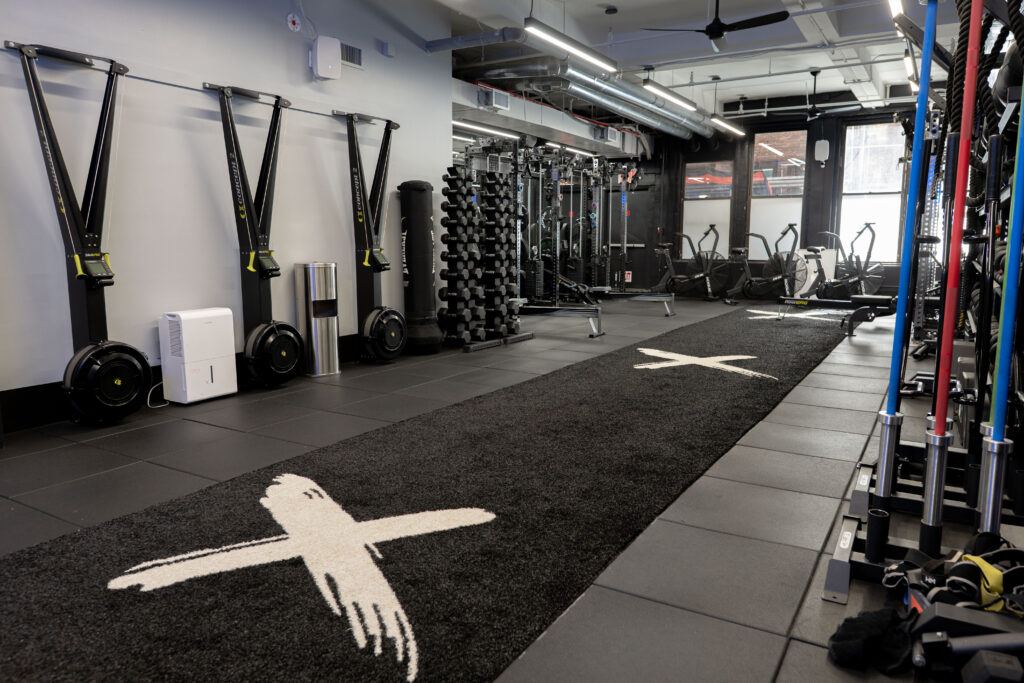
If there’s one thing I hope you take away from this article, it’s that becoming an independent personal trainer isn’t simply the next step after working in a commercial gym.
It’s a different career with a different set of opportunities, responsibilities and challenges.
The coaching itself probably won’t change very much. If you’re already helping people achieve great results, you’ll continue doing exactly that.
What changes is everything that surrounds the coaching. You’re no longer just responsible for delivering a great session. You’re responsible for building the business that allows those sessions to happen in the first place.
For the right person, that can be incredibly rewarding.
The opportunity to build something that’s genuinely your own, choose the clients you work with, create the experience you believe in and shape a business around the life you want to live is something many trainers never regret pursuing.
But independence isn’t a reward for becoming a good coach. It’s a different career altogether, with a different set of opportunities, responsibilities and challenges.
Some trainers discover they love running a business just as much as they love coaching.
Others realise they’re happiest focusing entirely on their clients while someone else takes care of everything around them.
Neither path is better. They’re simply different.
That’s why I would encourage you not to think about this as a choice between success and failure, or between ambition and playing it safe.
Think about it as choosing the business model that best fits where you are today.
If you’ve recognised yourself in the Learning or Questioning stages of the Independence Readiness Spectrum™, your next step may simply be to gain more experience, strengthen your coaching skills and begin exploring what independence could look like.
If you’re already building your client base, developing your systems and becoming excited by the idea of running your own business, it may be the right time to take the next step with greater confidence and clearer expectations.
The important thing is not to rush the journey. Every successful independent trainer I know has built their business one client, one relationship and one good decision at a time.
None of them became successful because they made a dramatic leap. They became successful because they stayed consistent long after the excitement of becoming independent had worn off.
If you’re thinking seriously about becoming an independent personal trainer, I’d encourage you to spend time around people who are already doing it.
Ask questions. Listen to their experiences. Learn from both their successes and the mistakes they would avoid if they were starting again today.
That’s one of the reasons we’ve built Group by ITS. It’s more than a place to rent training space. It’s a professional environment where independent trainers can build their businesses, learn from one another and focus on delivering a great experience for their clients.
For more than two decades, it’s been a place where independent trainers have been able to build their businesses in a professional environment, learn from one another and focus on what they do best: helping their clients achieve results.
Whether you’re ready to make the move today or you’re simply exploring what independence might look like in the future, the most important thing is that your next decision is an informed one.
If you’d like to see what an independent training environment looks like in practice, you’re always welcome to visit Group by ITS, meet the community and have a conversation.
There is no pressure to make a decision.
Sometimes the clearest decisions don’t come from reading another article. They come from seeing what’s possible, asking good questions and having honest conversations with people who’ve already walked the path you’re considering.
Thinking about becoming independent?
You don’t have to make the decision today.
Come and see what independent training looks like in practice. Meet the community, ask questions and take a look around. Whether you’re ready now or simply exploring your options, we’d be happy to help you make a more informed decision.