
Hi, I’m Rick Richey. I help personal trainers take control, grow their businesses, and thrive, backed by 20+ years of real-world experience.
If you’re about to launch your first fitness class, there’s something I’d like you to consider before you book a venue, design a timetable or start posting on social media.
Most fitness classes don’t fail because the instructor isn’t good enough.
They fail because the business behind the class wasn’t ready.
I’ve met plenty of outstanding coaches over the years. They knew how to motivate people, they cared about their members and they genuinely wanted to help.
But coaching ability on its own doesn’t guarantee a successful group fitness business.
Running your own classes means making decisions about pricing, scheduling, positioning, marketing and member experience long before anyone walks through the door.
That’s where many new instructors come unstuck.
They’re excited to get started, which is completely understandable. They spend hours planning workouts, choosing playlists and thinking about the type of class they want to teach.
What they don’t spend enough time doing is asking whether they’ve built the foundations that will give their class the best chance of succeeding.
Enthusiasm is important. Every successful instructor starts with it. But enthusiasm isn’t a business plan, and confidence isn’t the same as preparation.
Whether you’re looking to start a fitness class, launch a group fitness class or build a long-term career running your own sessions, the work that determines your success happens well before your first member arrives.
If you’re still deciding whether working independently is the right move, read our guide Should You Become an Independent Personal Trainer?
The strongest businesses are rarely built by the instructors who move the fastest.
They’re built by the ones who take the time to understand who they’re serving, what problem they’re solving and how they’re going to create an experience that keeps people coming back.
That’s exactly what this guide is about.
Rather than giving you a checklist of things to do the night before you open the doors, I want to help you think like a business owner from day one.
By the end of this article, you’ll have a much clearer idea of whether you’re genuinely ready to launch, the questions you still need to answer and the foundations that will give your first fitness class the best possible chance of becoming a successful business rather than just another good idea.
Table of Contents
Why Enthusiasm Isn’t Enough

One of the biggest mistakes I see instructors make is assuming that because they’re a good coach, they’re ready to run their own fitness class.
The two aren’t the same thing.
I’ve met plenty of coaches over the years who are exceptional at what they do.
They know how to help people move better, build strength and achieve results.
Their clients trust them, enjoy training with them and regularly recommend them to friends. From a coaching perspective, they’re doing an outstanding job.
Unfortunately, none of that automatically means they’ll build a successful business.
Running your own class asks different questions.
- Can you clearly explain who your class is for?
- Does it solve a problem people genuinely care about?
- Have you created something that people are prepared to commit to week after week?
- Have you thought about pricing, scheduling and the overall experience your members will have from the moment they discover you to the moment they leave each session?
Those aren’t coaching questions. They’re business questions.
It’s completely natural to feel excited about a new idea, particularly when people tell you they’d love to come to your class.
That enthusiasm is important because it gives you the confidence to get started. The mistake is assuming that enthusiasm on its own is enough to justify launching.
Before you launch, it’s worth asking yourself whether your confidence is based on encouragement or evidence.
There’s a big difference between someone saying, “I’d definitely come to that,” and someone committing to a place in your first class.
One is encouragement; the other is validation. The more evidence you can gather before you begin, the fewer surprises you’ll face once your doors are open.
That’s why I always encourage instructors to spend more time validating their idea than perfecting their first workout.
The quality of your coaching will absolutely matter once people arrive, but your first challenge isn’t delivering a brilliant session—it’s building a class that people want to join in the first place.
Planning won’t remove every challenge, and there will always be lessons you’ll only learn by doing.
What good planning does is stack the odds in your favour. It gives you a stronger foundation, helps you make better decisions and allows you to launch with purpose instead of simply hoping everything will fall into place.
Have You Proved There’s Genuine Demand?
One of the easiest mistakes to make when you’re excited about launching your first fitness class is assuming that because you think it’s a good idea, other people will too.
It sounds obvious when you read it, but it’s something almost every instructor falls into at some point.
I’ve spoken to coaches who have spent weeks designing the perfect programme, creating a logo, setting up social media accounts and even ordering branded clothing before they’ve found out whether anyone actually wants to attend the class.
By the time they announce it, they’ve invested so much time, money and emotion into the idea that changing direction feels like failure.
The problem is that enthusiasm can sometimes hide reality.
The only opinion that really matters before you launch is the opinion of the people you’re hoping will become your members.
That doesn’t mean asking your friends whether they like the idea.
Friends are usually supportive because they want to encourage you. Family will often tell you it’s a brilliant idea because they believe in you. Existing clients may even say they’d love to come along because they already enjoy working with you.
Those conversations are encouraging, but they aren’t proof of demand. Real validation happens when people are prepared to do something that requires commitment.
That might mean joining a waiting list, paying a deposit, booking onto a pilot session or giving you a definite yes when you ask if they’ll attend your first class.
There’s a big difference between someone saying, “I’d be interested,” and someone taking an action that shows they’re genuinely committed.
One approach I often recommend is starting as small as possible. Instead of announcing a twelve-week programme with multiple weekly sessions, invite a handful of people to a single pilot class.
You’ll learn far more from ten real participants than you ever will from a hundred social media likes or positive comments.
You’ll discover what people enjoyed, what confused them, whether the timing worked and whether they’d happily come back the following week.
That’s valuable information because it allows you to improve before you commit significant time and money.
It’s also worth paying attention to the questions people ask you.
If everyone wants to know how much the class costs, that’s useful feedback.
If they ask where it’s being held, what level it’s aimed at or whether they can bring a friend, those questions tell you what’s important to your future members.
If nobody asks anything or nobody follows up after expressing interest, that tells you something as well.
Sometimes the biggest lesson isn’t that your idea is wrong. It’s that your message isn’t clear enough.
A successful launch isn’t built on hope; it’s built on evidence. Before you spend time worrying about logos, websites or social media, make sure you’ve answered the most important question of all:
Have enough people shown they’re willing to give your class a chance?
If the answer is yes, you’re ready to move to the next stage. If the answer is no, don’t see that as a setback. See it as an opportunity to refine your idea while the cost of making changes is still low.
It’s far easier to adjust your concept before your first class than it is after six disappointing weeks of trying to fill empty spaces.
Does Your Class Solve a Problem People Actually Care About?
One of the first conversations I have with instructors who are thinking about running their own classes usually starts with a simple question:
“Why would someone choose your class?”
At first, the answers are often very similar. They’ll tell me it’s a strength class, a bootcamp, a mobility session or a high-energy group workout. They’ll explain the programming, the equipment they’ll use or how they’ll structure the sessions.
All of that is important, but it isn’t usually why somebody decides to become a member.
Think about the way you make buying decisions yourself.
Most of us aren’t looking for products or services for the sake of it. We’re looking for a solution to a problem, a way to achieve something that’s important to us or an experience that improves our lives in some way.
Fitness is no different.
Very few people wake up one morning and think, “I’d really like to join a 45-minute circuit class.”
What they’re actually thinking is something much more personal.
They want to lose weight after years of trying. They want to build enough strength to feel capable again. They want to reduce the back pain that’s stopping them enjoying everyday life.
They want to improve their health as they get older, regain confidence after having children or simply find somewhere they feel comfortable exercising without feeling judged.
Those are the reasons people start looking for help.
Your class is simply the vehicle that helps them get there.
That’s an important distinction because it changes how you think about everything from your marketing to the experience you create once people arrive.
If all you talk about is the workout, you’ll naturally focus on exercises, equipment and programming. Those things certainly matter, but they rarely form the emotional reason someone chooses one class over another.
People are far more interested in the outcome they hope to achieve.
If someone has struggled with their weight for years, they’re looking for a programme that finally helps them make progress.
If they’re worried about getting older and becoming less mobile, they’re looking for reassurance that they can stay active and independent.
If they’ve never really enjoyed commercial gyms, they may simply be looking for a welcoming community where they feel comfortable walking through the door each week.
When you begin to think that way, your business becomes much clearer because you’re no longer trying to sell a fitness class. You’re offering a solution to a problem that somebody genuinely wants to solve.
This is also where many new instructors make life unnecessarily difficult for themselves.
They try to create a class that appeals to everyone because they don’t want to exclude anybody.
The reality is that the broader your message becomes, the harder it is for anyone to recognise that you’re speaking directly to them.
A class designed to help women over 50 build strength and maintain their independence paints a very different picture from one simply described as a “full-body fitness class.”
Likewise, a small group coaching programme for recreational runners who want to stay injury-free is far easier for the right people to identify with than a generic conditioning session aimed at everybody.
Being specific doesn’t reduce your opportunities.
More often than not, it increases them because the people you’re trying to help immediately recognise themselves in your message.
Before you launch your first fitness class, take a few minutes to answer one question honestly.
If a prospective member asked why your class exists, would your first instinct be to describe the workout, or would you explain the problem it solves and the outcome it helps people achieve?
The instructors who build lasting businesses almost always start with the second answer.
They understand that members aren’t buying forty-five minutes of exercise. They’re investing in a better version of themselves, and they’re looking for a coach who understands exactly how to help them get there.
Can You Clearly Describe Your Ideal Member?

One of the phrases you’ll hear a lot in marketing is “know your ideal client.” It’s good advice, but I think it often gets overcomplicated.
You don’t need to invent a fictional person with a made-up name, favourite coffee shop and colour-coded personality profile before you can launch a successful fitness class.
What you do need is a very clear picture of the type of person you’re trying to help.
When I ask instructors who their class is for, one of the most common answers is, “It’s really for anyone who wants to get fitter.” I understand why people say that. Nobody wants to turn potential members away before they’ve even opened the doors.
The problem is that if your class is designed for everyone, it’s much harder for anyone to feel that it’s specifically for them.
Think about the people you’ve enjoyed coaching the most throughout your career.
Chances are, certain clients immediately come to mind. Perhaps it’s the woman who’d never stepped inside a gym before but gradually grew in confidence.
Maybe it’s the busy father who wanted enough energy to keep up with his children, or the runner who simply wanted to stay healthy and avoid recurring injuries.
Those aren’t just clients.
They’re clues.
They tell you where you’ve already done your best work and where your experience can genuinely make the biggest difference.
Rather than trying to attract everyone, start by thinking about one person you would love to coach again.
What stage of life are they at? What frustrations do they talk about every week? What have they tried before that hasn’t worked?
More importantly, what are they hoping will be different six months after joining your class?
The answers to those questions will tell you far more than simply knowing someone’s age or occupation.
If you understand what frustrates people, what they’re worried about and what success looks like from their perspective, you’ll naturally communicate in a way that feels relevant to them.
They’ll read your website, social media posts or class description and think, “That sounds exactly like me.”
That’s when people start paying attention.
It also makes every other business decision easier.
You’ll find it simpler to choose the right class format because you’ll know what your members actually need.
Pricing becomes clearer because you’ll understand the value you’re creating. Even your timetable starts to make more sense because you’re planning around the lifestyle of the people you’re trying to help, rather than fitting classes into the gaps in your own diary.
One of the biggest advantages independent instructors have over large commercial gyms is that they don’t have to appeal to everyone.
In fact, they shouldn’t.
The strongest independent businesses are usually built by coaches who become known for helping a particular type of person solve a particular type of problem.
Over time, that reputation becomes one of their greatest strengths because satisfied members naturally recommend the class to friends, family and colleagues who are looking for exactly the same thing.
Before you launch your first fitness class, ask yourself one final question.
Can you picture the first person you want walking through the door?
If you can describe them with confidence—the challenges they face, the goals they’re working towards and the type of support they’re looking for—you’ll find it much easier to build a class that genuinely connects with the people you want to serve.
If the answer is still, “Anyone who wants to get fit,” I’d spend a little more time refining your thinking before you launch.
The clearer you are about who you’re trying to help, the easier it becomes for those people to recognise that your class was created with them in mind.
Have You Chosen the Right Class Format?
Once you’re clear about who you want to help and the problem you’re trying to solve, choosing the right class format becomes much easier.
The mistake many new instructors make is choosing the style of class they enjoy teaching most, rather than the one that’s best suited to the people they want to serve.
Those two things aren’t always the same.
I’ve seen instructors launch high-intensity bootcamps because they love that style of training, only to discover that the people they were hoping to attract felt intimidated before they even arrived.
Equally, I’ve seen coaches create gentle mobility classes when their audience was actually looking for the challenge and camaraderie of a structured strength programme.
The format should always support the outcome your members are looking for.
If your audience wants to build strength, improve confidence and feel more capable in everyday life, then a small group strength programme may be exactly what they need.
If you’re working with recreational runners who want to stay injury-free, mobility and strength might form the foundation of your sessions.
If your members are looking for energy, variety and a strong sense of community, a bootcamp or hybrid-style class could be a much better fit.
The important point is that every format attracts different people and creates a different experience.
A traditional bootcamp often appeals to members who enjoy variety, outdoor training and a fast-paced environment.
Small Group Personal Training usually attracts people who want more individual coaching while still benefiting from the motivation of training alongside others.
If you’re considering Small Group Personal Training, it’s also worth understanding the advantages of hiring professional training space rather than trying to run sessions wherever you can find room.
Strength-focused classes appeal to those who value measurable progress and long-term physical development, while boxing-based sessions often attract people looking for a fun, energetic workout that also helps relieve stress.
Mobility classes tend to appeal to those recovering from injury, managing stiffness or wanting to move with greater confidence, and hybrid programmes can combine several of these elements when there’s a clear reason for doing so.
None of those formats is inherently better than another.
The best choice is the one that allows you to deliver outstanding coaching while helping your members achieve the outcomes that matter most to them.
That’s also why I encourage instructors not to chase trends.
Every few years the fitness industry discovers the next big thing. New training methods appear, social media fills with coaches trying to replicate them and suddenly everyone feels they should be offering the same type of class.
The problem is that trends come and go, but a class built around the genuine needs of your members has a much better chance of standing the test of time.
It’s also worth thinking about yourself as the coach.
Can you see yourself delivering this class every week for the next three or five years?
Does it play to your strengths, your personality and the type of coaching you genuinely enjoy?
Your members will quickly recognise whether you’re teaching something you believe in or simply following what’s fashionable.
The strongest classes are usually built where three things come together.
First, there’s a genuine problem your members want to solve. Second, there’s a class format that’s well suited to helping them achieve that outcome. And third, there’s a coach who genuinely enjoys delivering that experience every single week.
When those three things are aligned, you’re no longer choosing a class format because it’s popular.
You’re choosing it because it’s the right solution for the people you’ve decided to serve.
Have You Tested Your Idea Before Committing?
One of the biggest advantages you have before launching your first fitness class is that nothing is fixed yet.
You haven’t committed to a long-term timetable. You haven’t filled a calendar with sessions. You haven’t built your reputation around a format that may or may not work.
That gives you the freedom to experiment.
Unfortunately, many instructors skip that stage altogether. They spend weeks planning, designing logos, building websites and promoting a class before they’ve ever delivered a single session to the people they’re hoping to attract.
There’s a much simpler approach. Test the idea first.
A pilot class doesn’t need to be perfect.
In fact, it shouldn’t be. Its purpose isn’t to impress people with polished branding or flawless delivery. Its purpose is to answer a series of important questions while the cost of making changes is still low.
- Did people enjoy the experience?
- Was the class the right length?
- Did the exercises suit the group?
- Was the atmosphere what you hoped it would be?
- Would people genuinely come back next week?
Those are the questions that matter.
If you already work with clients, they’re often the best place to begin. Existing clients already know and trust you, which means they’re usually happy to give honest feedback about what’s working and what could be improved.
They’re also much more likely to tell you when something doesn’t quite make sense, and that’s incredibly valuable at this stage.
Friends and family can certainly help you practise your coaching or build confidence delivering a session, but I’d be cautious about treating their opinions as proof that you’ve found a winning idea.
The people closest to you naturally want to be supportive, and that can sometimes make their feedback more encouraging than objective.
Ultimately, the opinions that matter most are those of the people who genuinely fit the audience you’re hoping to serve.
When the pilot session is over, resist the temptation to ask, “Did everyone enjoy it?” Most people will politely say yes.
Instead, ask more specific questions.
- What did you enjoy most?
- Was anything confusing?
- What almost stopped you coming today?
- Would you pay to attend this every week?
- What would make the experience even better?
Those conversations will teach you far more than compliments ever will.
The important thing is to see feedback as part of the process rather than as criticism.
Every successful class evolves over time. Timetables change, exercises are refined, pricing is adjusted and the overall experience improves as you learn more about the people you’re coaching.
That isn’t a sign that your original idea was wrong. It’s a sign that you’re listening, learning and building something around the needs of your members instead of your own assumptions.
I think that’s one of the biggest differences between instructors who build successful businesses and those who struggle to gain momentum.
Successful instructors don’t see launching as the finish line.
They see it as the beginning of a continual process of learning and improving.
If you can adopt that mindset before your first official class, you’ll make better decisions, adapt more quickly and give yourself a much stronger foundation for long-term success.
Will Your Pricing Actually Work?
When instructors start thinking about pricing, the question they usually ask is, “What should I charge?”
I don’t think that’s the right place to start. A better question is, “Can this become a sustainable business?”
There’s no such thing as the perfect price in isolation. A price only makes sense when you look at the bigger picture.
How many people can you realistically accommodate? What are your costs? How many classes will you run each week? And most importantly, what does the business need to generate for it to be worth your time and energy?
Those questions matter far more than simply looking at what another instructor is charging down the road.
One of the biggest mistakes I see is people pricing their classes by comparison. They look at the local market, notice that everyone else charges around the same amount and decide to do something similar without ever working out whether the numbers actually stack up.
Sometimes they even go a step further and charge less because they think lower prices will attract more members.
It often does the opposite.
Lower prices can make it harder to build a profitable business, and they don’t necessarily make your class more attractive.
If people don’t understand the value of what you’re offer, reducing the price rarely solves the problem. It simply means you have to work harder to earn the same income.
Instead, work backwards.
Imagine your class can comfortably accommodate twelve members. How many places do you need to fill before you cover your venue costs, insurance, equipment and your own time?
If you’re not sure where to start, our guide on how many clients you need to be profitable in group fitness walks through the numbers and shows you how to calculate your own break-even point.
At what point does the class become profitable? If every space is filled, does the income justify the preparation, coaching and administration that happens outside the session itself?
These are the calculations every business owner needs to make before launching, not six months afterwards when they’re wondering why they’re working so hard without seeing the financial return they expected.
Pricing is also part of your positioning.
A premium coaching experience with small class sizes, individual attention and structured progression naturally commands a different price from a large bootcamp held in the park.
Neither approach is right or wrong, but the price should reflect the experience you’re delivering and the value your members receive.
The goal isn’t to be the cheapest option.
It’s to be the obvious choice for the people you’ve decided to serve.
If you’re constantly competing on price, there’s almost always someone willing to charge less. Competing on value is a much stronger long-term strategy because it shifts the conversation away from cost and towards results, coaching and the overall experience your members receive.
Before you launch your first class, spend some time running the numbers. Ask yourself whether the business still works if only half the places are filled for the first few weeks.
Think about what happens when you reach capacity. Consider whether your pricing gives you room to grow, invest and continue improving the experience for your members.
Launching a class is exciting. Building one that’s still thriving three years from now requires a different way of thinking.
The instructors who achieve that don’t set their prices by guessing or copying someone else. They understand the numbers behind their business and make pricing decisions that support the future they’re trying to build.
Have You Planned Your Timetable Around Your Members?

Choosing when to run your classes might seem like a practical decision, but it can have a huge influence on whether your business grows or struggles.
One of the easiest traps to fall into is building a timetable around your own availability.
You look at your diary, decide when you’re free and schedule classes accordingly. On the surface, that seems perfectly logical, but it overlooks the most important question.
When are your members actually available to train?
The answer will depend entirely on the people you’re trying to help.
If your members are busy professionals, early mornings, lunchtime sessions or evenings may fit naturally into their working day.
If you’re coaching parents with young children, the school run could shape their availability far more than the clock.
If you’re working with older adults or people in retirement, mid-morning or early afternoon may be much more appealing than a 6.00 a.m. start.
This is another reason why understanding your ideal member is so important.
The better you understand their daily routine, the easier it becomes to build a timetable that works with their life rather than asking them to reorganise it around yours.
Convenience plays a much bigger role than many instructors realise.
Even the best-designed class will struggle if people regularly have to choose between attending and getting to work on time, collecting the children from school or sitting in heavy traffic after a long day.
Every bit of unnecessary friction makes it less likely that someone will become a regular member.
That’s why consistency matters just as much as convenience.
People build exercise into their lives through routine. If your class is always on the same days and at the same times, it becomes part of their weekly schedule.
They stop making a fresh decision every week about whether to attend because the class has simply become something they do.
That consistency also makes life easier for you as the instructor. Members know when to expect sessions, attendance becomes more predictable and it’s much easier to build momentum as your community grows.
It’s tempting to keep changing your timetable in the hope of attracting more people, especially during the early months.
Sometimes adjustments are necessary, particularly if you’re responding to genuine feedback, but constantly moving sessions around can make it difficult for members to establish the habits you’re trying to encourage.
Remember, you’re not simply filling spaces on a timetable. You’re helping people create a routine they can maintain for months and years.
Before you finalise your schedule, imagine a typical week in the life of your ideal member. Think about when they’re most likely to have the time, energy and motivation to exercise.
Consider what’s happening immediately before and after the class, and ask yourself whether attending feels convenient or whether you’re unintentionally asking people to fit your business around the rest of their lives.
The strongest timetables are rarely built by chance. They’re designed around the people they’re intended to serve.
Are You Launching a Class—or Building a Business?
If you’ve read this guide from the beginning, you’ll probably have noticed that we’ve spent surprisingly little time talking about exercise.
That isn’t an accident.
Being able to coach a great class is important, but it’s only one part of building a successful independent business.
Over the years I’ve met plenty of instructors who could deliver fantastic sessions. Their members enjoyed training with them, the coaching was excellent and the atmosphere in the room was exactly what you’d hope for.
Yet, within a year or two, many of those classes had disappeared. It wasn’t because the coaching wasn’t good enough.
It was because they were relying on great coaching to solve problems that were actually business problems.
When you’re employed by a gym, someone else usually takes care of the things happening around the session.
Someone answers enquiries, manages bookings, processes payments, keeps the facility running and thinks about marketing.
As an independent instructor, those responsibilities become yours. The class itself might only last an hour, but the business exists for the other twenty-three hours of the day as well.
That’s the shift many people underestimate.
Your members don’t judge their experience solely on what happens during the workout.
Their impression starts the moment they first hear about you. It continues when they visit your website, send an enquiry or book their first class.
It develops through every email you send, every conversation you have and every interaction they experience after they’ve become a member.
When all of those pieces work together, people notice.
They might not consciously think about how easy it was to book or how smoothly everything ran, but they remember how the experience made them feel.
They feel looked after. They feel valued. They feel confident recommending you because every part of the business reflects the same level of professionalism.
That’s why systems and processes matter.
I know those words can sound a little intimidating, particularly if you’ve never thought of yourself as a business owner.
In reality, a system is simply a consistent way of doing something. It could be the way you welcome every new member, how you follow up after someone’s first session or the process you use when somebody misses a couple of weeks of training.
None of those things is particularly complicated on its own. The difference comes from doing them consistently.
Consistency creates trust. Trust creates loyal members. Loyal members build sustainable businesses.
One of the biggest misconceptions in our industry is that professionalism comes from having the newest equipment, the slickest branding or the biggest social media following.
Those things can certainly help, but they aren’t what people remember most.
People remember how you made them feel.
They remember whether they felt welcomed when they walked through the door for the first time. They remember whether somebody noticed when they’d made progress. They remember whether they felt like another booking on the timetable or a genuine part of the community.
That’s the experience people come back for. It’s also the experience they tell their friends about.
As you move towards launching your first class, I’d encourage you to think beyond opening day.
It’s exciting to imagine a full room, a great atmosphere and people leaving with a smile on their face. Those are important milestones, but they’re only the beginning of the journey.
Ask yourself what happens next.
- What happens after someone’s first class?
- How do they become a regular member rather than someone who attends once or twice?
- How do you keep them engaged six months from now?
- What will make them still be training with you in three years’ time?
Those questions don’t have to be answered perfectly before you launch, but they do need to be part of the way you think.
The instructors who build businesses that last aren’t necessarily the ones who write the most creative workouts or deliver the hardest sessions.
More often than not, they’re the ones who consistently create an experience that people trust, enjoy and want to be part of.
Their members know what to expect, they feel valued and they become advocates for the business because every interaction reinforces the decision they made to join.
That’s why I’d leave you with one final thought before you launch your first class. If your ambition is simply to run a great session every week, you’ll probably achieve it.
If your ambition is to build a business that people are still talking about years from now, you’ll need to think beyond the workout.
You’ll need to think about the experience you’re creating, the relationships you’re building and the systems that allow your business to grow without compromising the quality of your coaching.
That’s the difference between launching a class and building a business.
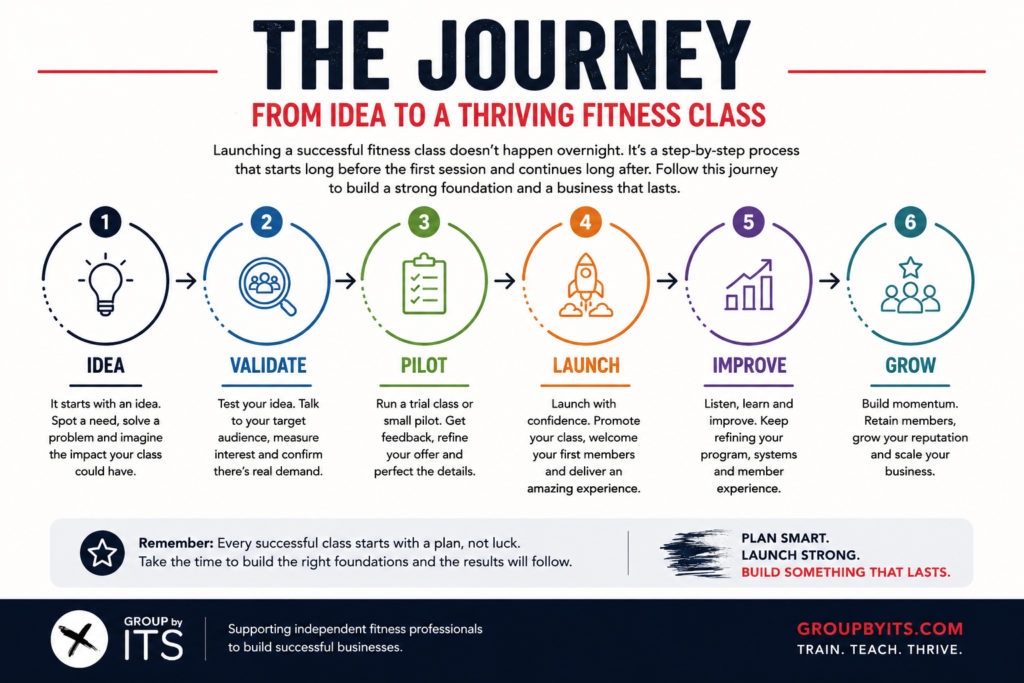
The Journey from Idea to Independent Business
Everything we’ve covered so far follows a simple progression.
Successful instructors don’t jump straight from an idea to launching a business. They take the time to validate, test and refine each stage before moving on.
Rick’s Perspective: Five Things I Wish Every Instructor Knew Before Launching Their First Class
After more than thirty years in the fitness industry, I’ve seen plenty of very good coaches build successful businesses, and I’ve seen equally talented people struggle to get beyond a handful of classes each week.
The difference was rarely their technical knowledge. Most of them could coach well, write a sensible programme and create a good atmosphere in the room.
What usually separated them was whether they understood that running a class and building a business are two different things.
Coaching is still at the centre of it, but once you become independent, you also have to think about the experience around the class, the people you’re trying to help and the decisions that will allow the business to keep going.
These are the five things I find myself coming back to most often when I speak to instructors who are preparing to launch.
Great Coaching Is Only Part of the Job
Most instructors start by thinking about the session itself. They plan the exercises, the timing, the music and the equipment, then spend even more time wondering whether everyone will enjoy it. That makes sense because coaching is the part of the job they already understand.
The problem comes when they assume a good session will take care of everything else. It won’t.
People form an opinion of your business long before the warm-up begins. They notice how quickly you reply to an enquiry, whether the booking process makes sense and how comfortable they feel when they arrive for the first time. Once they join, they notice whether you remember them, whether communication is clear and whether the class feels organised from one week to the next.
None of that requires an elaborate system. It simply requires you to pay attention to the whole experience rather than treating the hour you spend coaching as the entire product.
I’ve known technically excellent coaches who struggled because everything outside the session felt improvised. I’ve also known instructors who built very loyal memberships because people always felt looked after. The coaching still had to be good, but it was the consistency around it that gave members confidence in the business.
Be Clear About Who the Class Is For
New instructors often worry that being too specific will reduce the number of people they can attract. As a result, they describe a class that could be for almost anyone: all abilities, all goals and all ages. It sounds inclusive, but it usually leaves people with very little reason to choose it.
You don’t have to create a class for such a narrow group that nobody else feels welcome. You do need to know who you are primarily trying to help and what they are hoping to get from the experience.
That clarity affects almost everything. It influences the way you structure the class, the language you use to promote it, the times you offer and the environment you create. A class for busy professionals who want to get stronger before work is not the same business as a daytime class for older adults who want to improve their balance and confidence, even if some of the exercises overlap.
When you become known for helping a particular kind of person well, referrals also become easier. People can explain what you do without having to give a long description, and the person hearing the recommendation can quickly decide whether it sounds relevant to them.
Pay Attention to What Your Members Are Telling You
It is very easy to become distracted by what other instructors are doing. You see a new class format, a different pricing model or another piece of equipment being promoted online, and you start wondering whether your own business should be moving in the same direction.
Sometimes those ideas are worth exploring. More often, the most useful information is already coming from the people you coach.
You hear it in the questions that come up repeatedly, in the reasons people give for missing sessions and in the comments they make when something works particularly well. A member may not sit down and give you a detailed analysis of your business, but over time you begin to see patterns. Perhaps new people are unsure what to expect before their first class. Perhaps one time slot regularly fills while another never does. Perhaps members value the social side of the class more than you realised.
Those observations give you something real to work with. They are much more useful than changing direction every time the industry becomes excited about a new trend.
Listening does not mean acting on every suggestion. It means understanding what people are experiencing and deciding whether there is a sensible improvement you can make.
Expect the Business to Change After You Launch
However much planning you do, you will not get everything right before the first class. Your original timetable may need adjusting, the pricing may need refining and the way you welcome new members will probably improve once you have taken a few people through the process.
That is not a sign that the launch failed. It is what happens when a plan meets real people.
The important thing is not to change everything at once. Give decisions enough time to produce useful information, then make adjustments for a clear reason. If one class time is consistently quiet, find out whether the issue is the time, the audience or the way it has been promoted before removing it. If people are not returning after their first visit, look carefully at the experience they had rather than immediately reducing the price.
Most good businesses are built this way. They become stronger through a series of practical improvements made over time. You learn what matters to your members, remove unnecessary friction and gradually develop a business that works better than the version you originally launched.
Think Beyond Opening Day
When you are preparing to launch, opening day can feel like the finish line. You are focused on getting enough bookings, making sure the room is ready and delivering a class that people enjoy. Once that first session is over, however, the work becomes much more ordinary.
You have to decide how new people will find you, how you will help them become regular members and what you will do when attendance starts to dip. You also begin to learn how much time the business takes outside the classes themselves and whether the model is giving you the income and freedom you expected.
You do not need to know exactly what the business will look like in five years, but it helps to have some sense of what you are trying to create. Some instructors want to teach a small number of classes themselves and keep the business simple. Others want to add more sessions, employ coaches or develop a larger community around the brand. Both can work, but they lead to different decisions.
The more thought you give to that early on, the less likely you are to build a business that eventually becomes difficult to manage or no longer suits the way you want to work.
Launching the class matters, but it is only the first step. What you do after that will determine whether it remains a weekly session you enjoy teaching or develops into a sustainable independent business.
The First Class Readiness Checklist
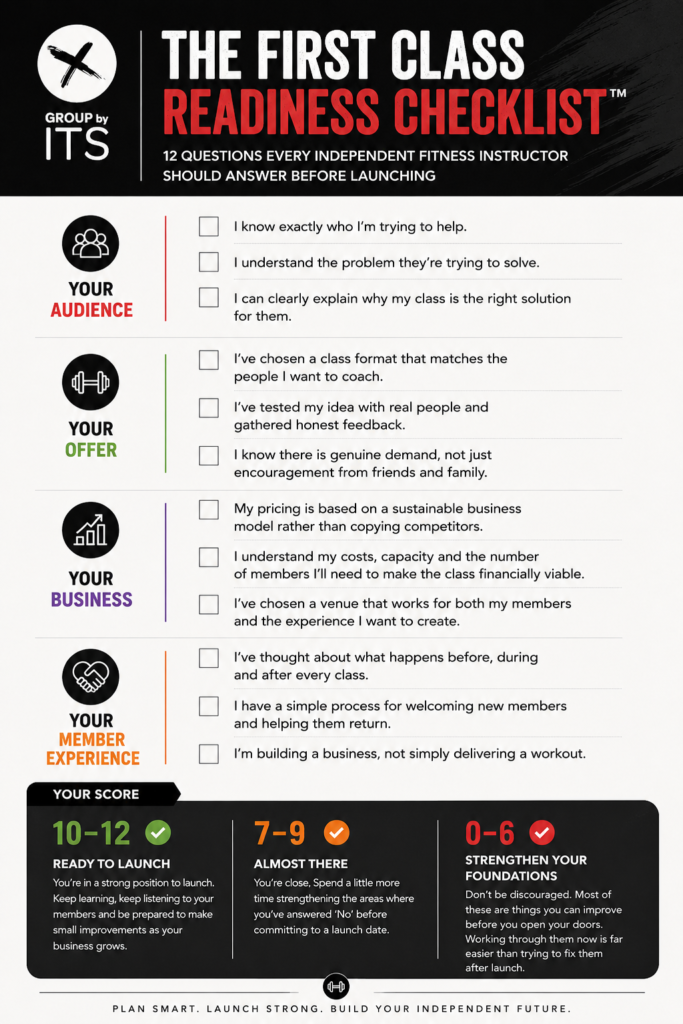
Before you commit to launching your first class, take a few minutes to work through the checklist below.
If you can confidently answer ‘Yes’ to most of these questions, you’re giving yourself a much stronger foundation than many instructors have when they first go independent.
If you answer ‘No’ to several of them, don’t see that as a reason to stop. See it as a clear indication of where you should spend your time before launch.
Your Audience
☐ I know exactly who I’m trying to help.
☐ I understand the problem they’re trying to solve.
☐ I can clearly explain why my class is the right solution for them.
Your Offer
☐ I’ve chosen a class format that matches the people I want to coach.
☐ I’ve tested my idea with real people and gathered honest feedback.
☐ I know there is genuine demand, not just encouragement from friends and family.
Your Business
☐ My pricing is based on a sustainable business model rather than copying competitors.
☐ I understand my costs, capacity and the number of members I’ll need to make the class financially viable.
☐ I’ve chosen a venue that works for both my members and the experience I want to create.
Your Member Experience
☐ I’ve thought about what happens before, during and after every class.
☐ I have a simple process for welcoming new members and helping them return.
☐ I’m building a business, not simply delivering a workout.
Your Score
10–12 ✓
You’re in a strong position to launch. Keep learning, keep listening to your members and be prepared to make small improvements as your business grows.
7–9 ✓
You’re close. Spend a little more time strengthening the areas where you’ve answered ‘No’ before committing to a launch date.
0–6 ✓
Don’t be discouraged. Most of these are things you can improve before you open your doors. Working through them now is far easier than trying to fix them after launch.
Ready to Launch or Still Developing?
One of the questions I’m asked most often is, “How do I know if I’m actually ready?”
There’s rarely a perfect answer because no business is ever completely finished before it opens its doors. Every instructor continues to learn once they’re working with real members.
What I have noticed, though, is that successful launches tend to have a number of things in common. The instructors behind them have usually taken the time to validate their idea, think through the member experience and understand the financial side of the business before advertising their first class.
Others launch with plenty of enthusiasm but spend the following months fixing problems that could have been avoided with a little more preparation.
The comparison below isn’t intended to judge where you are today. Instead, think of it as a way of identifying which areas already feel solid and which ones might benefit from a little more attention before you launch.
| AREA | READY TO LAUNCH | STILL NEEDS WORK |
| Demand | You’ve spoken to potential members and know there’s genuine demand for the class. | You’re hoping people will come but haven’t tested the idea with your target audience. |
| Pricing | Your pricing reflects your costs, your value and the long-term sustainability of the business. | Your pricing is based mainly on what competitors charge or what feels “about right.” |
| Venue | The venue is convenient, appropriate for your audience and supports the experience you want to create. | The venue was chosen because it was available or inexpensive, rather than because it’s the best fit. |
| Confidence | You can clearly explain who the class is for, the problem it solves and why someone should choose it. | You’re still refining your message and find it difficult to explain exactly what makes your class different. |
| Systems | You have a simple process for enquiries, bookings, payments and welcoming new members. | Most tasks will be handled as they arise, with little consistency from one member to the next. |
| Timetable | Your class times have been chosen around the lifestyle and availability of your ideal members. | The timetable is based mainly on when you’re available to teach. |
| Member Experience | You’ve planned what happens before, during and after each class to help members feel supported and encourage them to return. | Your focus is almost entirely on delivering a good workout, with less attention given to the overall member journey. |
If you recognised yourself in the “Still Needs Work” column more often than the “Ready to Launch” column, don’t let that put you off. Every independent instructor starts somewhere, and most successful businesses evolve over time rather than appearing fully formed on day one.
The important thing is knowing what needs attention before you commit your time, money and reputation to a launch. A few weeks spent strengthening the foundations now can save months of frustration later.
Frequently Asked Questions About Launching Your First Fitness Class
Even after you’ve worked through the planning process, there are usually a few practical questions that remain. These are some of the ones I’m asked most often by instructors preparing to launch their first class.
How many people should I have before launching my first class?
There isn’t a magic number. The right number depends on your costs, pricing and the size of your class. Rather than waiting until every space is filled, focus on validating demand and making sure the class is financially viable. Launching with a smaller group also gives you the opportunity to refine your coaching, gather feedback and build momentum before expanding.
Should I offer my first class for free?
A free class can work well if it’s part of a clear strategy, but it shouldn’t become your selling point. An introductory session is a good way to let people experience your coaching and reduce the barrier to trying something new. Just make sure people understand what happens afterwards and what the ongoing cost will be if they decide to continue.
What insurance do I need before teaching fitness classes?
Before teaching independently, you should have appropriate insurance in place. In most countries, this includes public liability insurance and professional indemnity insurance, although requirements vary. Check with your insurer, professional association and venue to make sure you have the correct cover before you begin teaching.
How much should I charge for my first class?
Charge a price that reflects both the value of your coaching and the costs of running the class. Avoid setting your prices simply by copying competitors. Sustainable pricing allows you to continue improving the experience you provide and build a business that works over the long term.
How often should I run my class?
Start with a schedule you can deliver consistently. One well-run class every week is far better than several sessions that are difficult to fill. As demand grows, you can add more classes based on what your members want rather than what you hope they’ll attend.
Should I rent gym space by the hour?
For many independent instructors, hiring space by the hour is a sensible way to start. It keeps overheads low, reduces financial risk and gives you flexibility while you build your membership. Just make sure the venue provides the experience your members expect, not simply the lowest rental cost.
What’s the biggest mistake instructors make before launching?
The biggest mistake is launching before they’ve properly validated their idea.
Many instructors spend months perfecting their workouts but very little time confirming that people actually want the class they’re planning to offer. Understanding your audience, testing demand and planning the member experience will usually have a greater impact on long-term success than making endless tweaks to the programme itself.
Conclusion
Launching your first fitness class is an exciting step, but it’s also one that deserves careful thought. The decisions you make before you welcome your first members can influence everything that follows, from the type of people you attract to the reputation you build in your local community.
No instructor gets everything right from day one. Every successful independent coach continues to learn, adapt and improve as their business grows. The goal isn’t to have a perfect plan before you start. It’s to make sure you’ve built solid foundations that give your class the best possible chance of succeeding.
If you’ve worked through the questions in this guide, completed the checklist and have a clear understanding of the people you want to help, you’re already in a much stronger position than many instructors are when they launch.
Take what you’ve learned, make the decisions that still need to be made and then have the confidence to get started. Your first class isn’t the end of the journey—it’s the beginning of building the business you want to own.
Ready to Take the Next Step?
If this guide has helped you decide that independent training is the right path, the next step is putting your plan into action.
At Group by ITS, we’ve created a professional training environment where independent fitness professionals can build and grow their own businesses without the cost, commitment and risk of opening a facility themselves.
Whether you’re preparing to launch your first fitness class or looking for a better place to coach your existing clients, we’ll help you take the next step with confidence.
Get Started by telling us a little about yourself. We’ll discuss your goals, answer your questions and help you determine whether Group by ITS is the right fit for your business.